
What a small business can automate
It is nearly always the same thing: a piece of data someone reads in one place and types again in another. The order that comes in by text and ends up in the spreadsheet. The supplier invoice that gets keyed into the books. Monday's report, assembled by copying from three sheets.
Each copy takes a minute and is a chance to type 15 where it said 51. That is the work worth taking off a person.
- What comes in. Orders, inquiries and bookings that someone logs by hand today.
- What gets read. Invoices, purchase orders and quotes that go from paper or PDF to data.
- What gets assembled. Reports and month-end numbers built by copying from several places.
- What gets answered. Questions that repeat: prices, hours, the status of an order.
A simple rule or AI automation: how to tell them apart
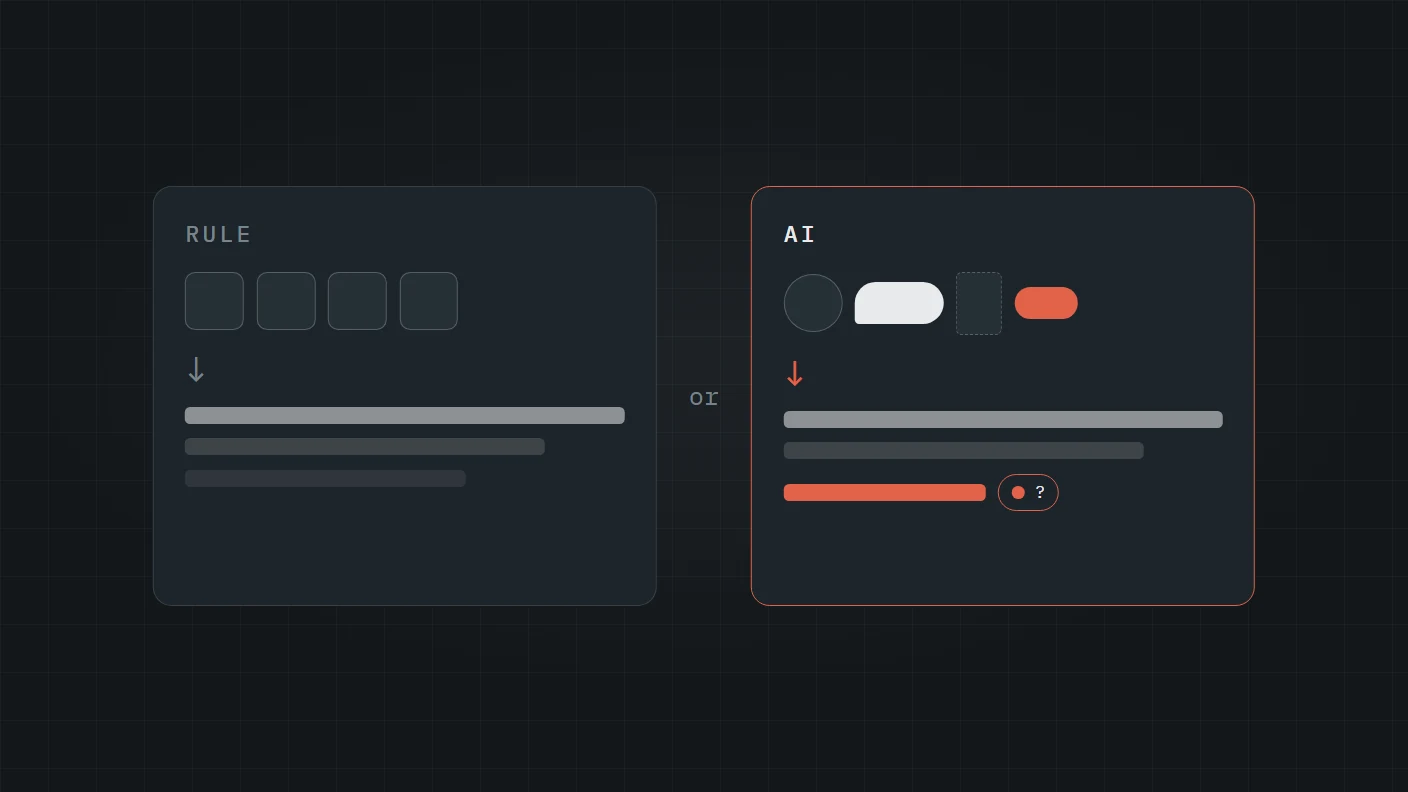
One question decides it: does what comes in always arrive in the same shape?
| How it arrives | What is enough | What it costs to keep running |
|---|---|---|
| Always the same: a form, a template, the email from the same supplier | A rule | Almost nothing. There is no model to pay for |
| Different each time: a voice note, a photo of the notebook, a half-finished message | AI | Model usage, every month, plus someone to review |
| A mix | A rule for the fixed part, AI for the rest | Less than using AI for everything |
A rule does the same thing every time, which is why it almost never fails. An AI model interprets, which is why it can handle what a rule can't read, and also why it can be wrong and sound sure about it. Using AI where a rule was enough means paying more for something less predictable.
Three things sold as AI that are really a rule
- The appointment reminder by text. It is a date and a template. It decides nothing.
- The alert when a form comes in. It is a forward, and nearly every form tool includes it.
- Monday's sales report. If the data already lives in a sheet or in your system, it is a scheduled query.
Ask for the quote to be split, line by line, into the part that uses AI and the part that doesn't. If they can't split it, they don't understand your process yet.
AI agent, chatbot or automation: the difference in one sentence
A rule does the same thing with whatever arrives the same way. A chatbot talks, using the information you gave it. An AI agent decides what step to take and takes it: it reads a message, understands it's an order, checks inventory and records it. The agent is the most useful of the three when what arrives is different every time, and the one that needs the most testing, because it acts.
Who reviews what the machine didn't understand
Almost nobody asks this before signing. Every automation meets an odd case sooner or later: the order with two addresses, the invoice photographed at an angle, the customer who writes across three messages.
If nobody receives those cases, the automation keeps failing and stops telling you. The same thing happens with a contact form that quit sending: nobody finds out until someone tests it. That is why a site audit checks the things nobody has looked at since launch.
Before you approve a project, ask who gets the unclear cases, through which channel, and how fast.
What AI automation for small business costs, and what you pay each month
There are two costs, and it helps to see them apart. The first is the project: mapping the process, building and testing. I charge a fixed price for it, from $1,200, and it is on the pricing page.
The second is model usage, paid to the AI provider every month, and it grows with volume. It is not part of my price, and I show it to you before you approve anything. A rule doesn't have that second cost.
The accounts are in your name from day one. If the AI provider account belongs to whoever built it, the automation isn't yours, the same way a website isn't yours when the domain is registered to someone else.
How to know if your business needs it: five days and a sheet of paper
You don't need to hire anyone to find out. For five days, make a tally mark every time someone copies a piece of data from one place to another. On Friday, count the marks and sort them by where the data came from.
The source with the most marks is where you start. And if there are only a few, you have your answer: you don't need AI automation yet, or any other kind. If there are a lot, tell me the number and where they come from.